

1.Describe the steps in wire line core drilling.
ü a. The drilling proceeds until core blockage or until the inner tube are filled with a core sample.
ü b. The overshot, which is attached to a wireline, is either lowered down the drill string or pumped into the drill string.
ü c. The overshot catches the inner tube assembly and releases it from the outer tube assembly.
ü d. The overshot and the inner tube assembly are hoisted up to the surface.
ü e. A new inner tube group is pumped down , or up, the drill string until it latches in the outer tube assembly.
ü f. The drilling starts new round again.
2. Which main components do a wire line core barrel consist of?
ü Outer tube group
ü Inner tube group
ü Overshot assembly
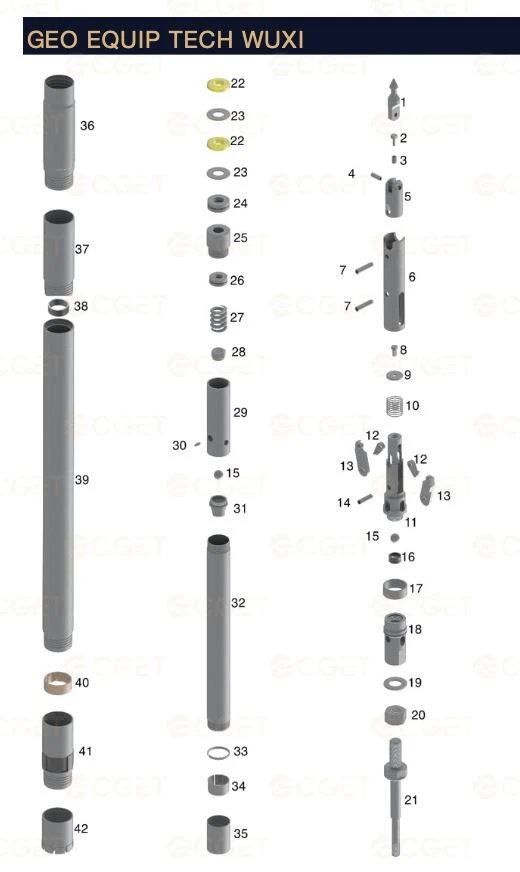
3.Which main components do the inner and outer tube assemblies of a wire line core barrel consist of?
ü The outer tube assembly includes the following parts:
Inner Tube Stabilizer
Locking coupling
Landing ring
Adapter Coupling
Outer tube
Reaming shell
Diamond Drill Bit
ü The inner tube assembly includes the following parts:
a. Head assembly
b. Inner tube
c. Landing shoulder
d. Stop ring
e. Core Lifter
f. Core lifter case
4.Which are the main differences between a core barrel head for a conventional core barrel and a core barrel head for a wire line core barrel?
ü On a conventional core barrel the inner and the outer tube is threaded to the core barrel head.
ü On a wire-line core barrel the inner tube is threaded to the core barrel head and this so called inner tube assembly is then held in place by a set of latches and the landing ring and shoulder.
5.What are the functions of the latches and the landing ring in a wire line core barrel?
ü The latches prevent the inner tube assembly from advancing up the drill string.
ü The landing ring prevents the inner tube assembly from penetration too far into the outer tube assembly.
6.Why is it important that the inner tube assembly has landed in the correct position before the drilling starts.
ü It is of outmost importance that the inner tube assembly actually has landed in the correct position before the drilling starts. If this, for some reason, is not the case and the drilling starts with the inner tube assembly in the wrong position this will be pushed into the drill string by the core sample.
ü The core sample will then be stored in the outer tube during drilling and the driller will probably loose the complete core from that particular core run.
7.How does the driller know that the inner tube assembly has landed in the correct position?
ü All wire line core barrels have some kind of a valve which should indicate that the inner tube assembly has landed. There are a number of different designs but two basic types can be identified. Both basic types of valves works on the principle that they block the water passage until the inner tube assembly has landed. When this happens the water pressure must reaches a preset value in order to open the valve and to give free passage for the flushing water.
ü An experienced driller does however have a number of ways to establish that the inner tube has landed in the correct position. He knows the time it takes for an inner tube assembly to travel down to the outer tube assembly. He listens for the specific sound that can be heard when the inner tube assembly lands in the correct position.
8.Which are the advantages and the disadvantages with a thin-kerf core barrel as compared to a standard core barrel?
ü A thin-kerf diamond drill bit contains fewer diamonds than a standard bit and
ü is therefore cheaper. A thin kerf bit does also require a lower feed force than a
ü standard bit and thus it has the possibility to drill a straighter hole.
ü A thin kerf bit produces a larger core sample than a corresponding standard core bit. A larger core sample is always an advantage for the geologists.
ü A disadvantage with the tin kerf wire line core barrel is that it can not withstand
ü rough treatment and they are therefore not recommended for drilling in very broken formation.
https://www.cgegtech.com/


